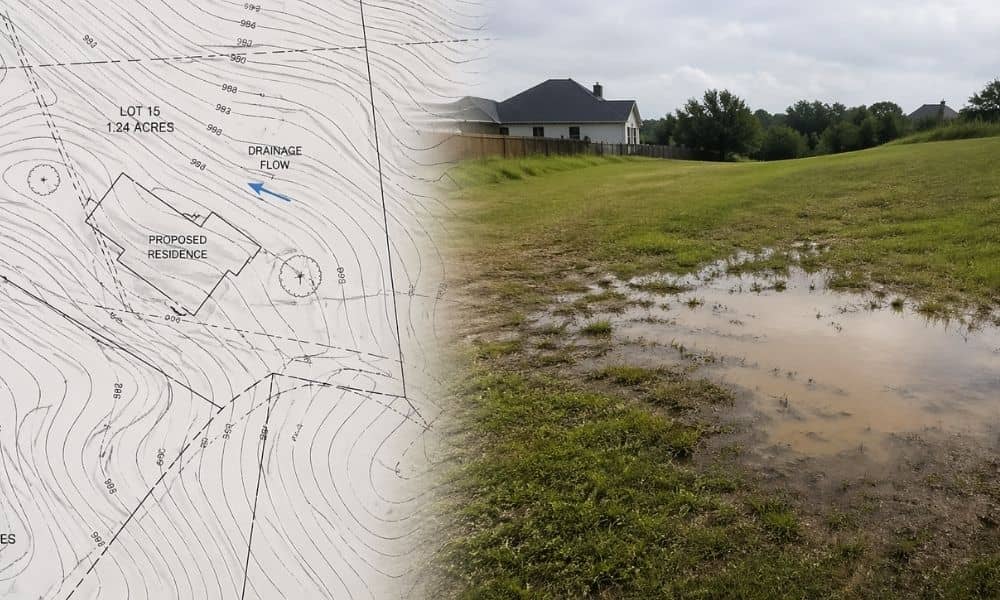
A lot of people assume a survey will show everything about their land. When you look at a topographic survey of your land, you see lines, numbers, and elevations, so it feels complete. It looks clean. It looks clear.
Then the project starts, and things don’t quite match what you expected.
Water shows up in spots that seemed flat. A driveway feels steeper than it looked on paper. A slab ends up needing to be raised. That’s when the question comes up: how did this not show in the survey?
It usually comes down to one thing. Most surveys in Fort Worth use 1-foot contours, and that level of detail doesn’t always tell the full story.
Why 1-Foot Contours Are Used in a Topographic Survey
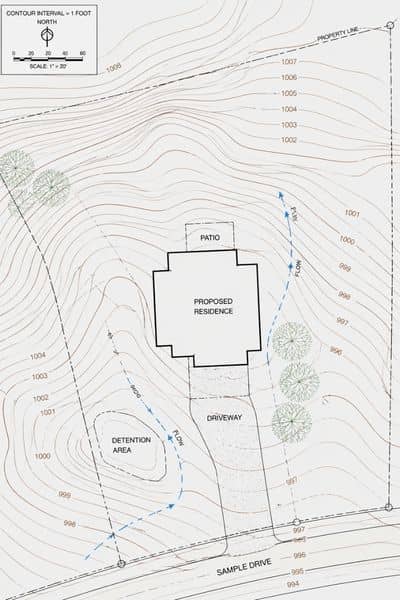
A topographic survey maps how land rises and falls. It does this with contour lines. Each line shows a change in elevation. With 1-foot contours, every line means the land changes by one full foot.
This method works well for many sites. It keeps the drawing easy to read. It also helps engineers get a quick sense of the overall slope of the land. For larger properties, that level of detail is often enough.
Because of that, 1-foot contours have become the standard starting point.
Still, that spacing leaves space between the lines. And inside that space, small changes can hide.
Small Elevation Changes Don’t Show Up Clearly
Not every change in the ground is a full foot. Some are only a few inches. These smaller shifts don’t create a new contour line, so they blend into the plan.
That may seem minor at first. Yet those small differences can change how a site behaves.
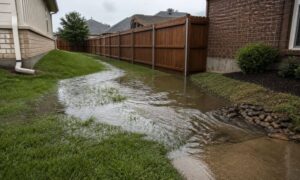
A slight dip in the ground can hold water after a storm. A gentle slope can push water toward a house instead of away from it. On paper, the land looks smooth. On site, it feels different.
In Fort Worth, where rain can come fast, even small low spots can cause trouble.
Water Doesn’t Always Follow the Lines You See
Contour lines suggest how water should move. Still, water doesn’t move in neat steps of one foot. It follows the smallest path downhill.
Because of that, a topographic survey with 1-foot contours can miss subtle drainage paths. The plan may show a simple slope, but the real flow may shift across the lot in ways that aren’t obvious.
This often shows up during construction. Crews expect water to move one way, but it moves another. That leads to changes in grading, which can slow the job down.
The issue isn’t the survey being wrong. It just doesn’t show the finer detail needed to predict that flow.
Driveway Slopes Can Feel Different in Real Life
Driveways are one of the first places where this shows up.
A survey may suggest a smooth slope from the street to the garage. Yet when the driveway is built, the change in elevation feels sharper.
That happens because short, quick changes in grade don’t stand out with 1-foot contours. The lines are too far apart to show those small shifts.
The result can be a driveway that feels steep or awkward. In some cases, vehicles scrape at the curb or struggle at the garage entrance.
Fixing that after the fact costs more than catching it early.
Grade Breaks Are Easy to Miss
A grade break is where the slope changes direction. It might shift from flat to sloped, or from one angle to another.
These breaks don’t always show clearly when contour spacing is wide. The land can look smooth on the plan even when it has small changes that matter during construction.
That affects how builders set the pad for a home or structure. It also affects how the finished surface lines up with surrounding areas.
A few inches can make a big difference in how everything fits together.
Retaining Wall Heights Can Be Off
Retaining walls depend on accurate elevation data. Even a small change in ground height can affect how tall the wall needs to be.
With 1-foot contours, those small changes may not stand out. A design might assume one height, but once the site is graded, the wall needs to be taller.
That leads to added material, added labor, and a higher cost than expected.
This happens more often on sites with mild slopes, where the changes are easy to overlook.
Some Sites Need More Detail Than Others
Not every project needs more than 1-foot contours. Many sites work just fine with that level of detail.
Still, some properties need a closer look.
Smaller lots often fall into this category. So do sites where the ground looks flat but has slight variations. Projects with tight grading limits also benefit from more precise data.
In these cases, surveyors can collect more detail where it matters. They may use tighter contour spacing or add spot elevations in key areas.
This doesn’t mean more work everywhere. It just means focusing on the parts of the site that need it.
Why This Matters for Projects in Fort Worth
Fort Worth has many sites that look flat at first glance. That makes small elevation changes easy to miss.
Those small changes still affect drainage, grading, and how a structure sits on the land. When they aren’t clear in the survey, they show up later during design or construction.
That can lead to delays, revisions, and added cost.
A topographic survey gives a strong starting point. Still, the level of detail matters just as much as the data itself.
When the survey matches the needs of the project, everything else moves more smoothly.