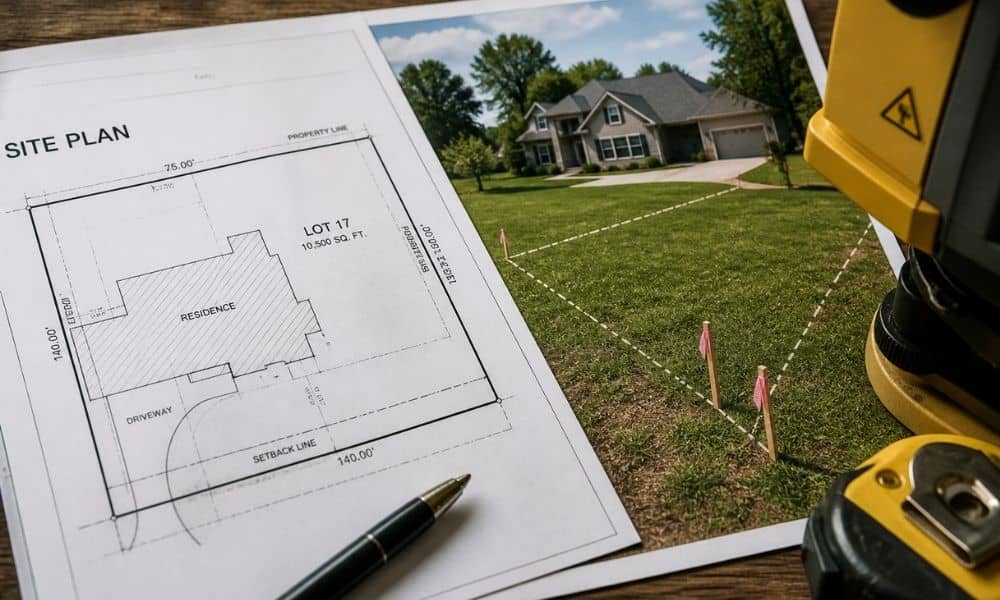
You’re looking at a drawing of your property. It shows your house, your driveway, and the space around it. It looks clean and official. So you think, “This must show my property line.”
That’s a very common mistake.
Many homeowners in Fort Worth rely on site plans, plot plans, or even appraisal sketches when making decisions. At first, those documents seem accurate. However, they are not meant to define ownership. Because of that, using them the wrong way can lead to confusion later on.
This is exactly the kind of issue people talk about online right now. Someone pulls out a plan, another person questions it, and suddenly no one is sure where the line really is. So instead of moving forward, everything slows down.
Why a site plan looks right but isn’t
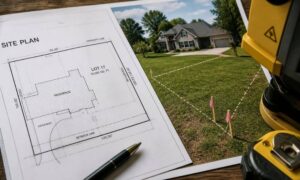
A site plan shows how things sit on a property. It helps builders and designers understand layout. For example, it may show the house, the driveway, and how much space sits around them. Because of that, it’s useful during planning.
However, a site plan is not built to confirm legal boundaries.
In most cases, the property lines on a site plan are scaled or estimated. They are based on earlier information, not on fresh field work. So even though the drawing looks detailed, the boundary lines may not be exact.
As a result, people assume they know where their property ends, even when the plan was never meant to answer that question.
The problem with relying on the wrong document
Many documents look official, so it’s easy to trust them. For example, homeowners often rely on appraisal sketches, closing papers, or online maps. Each one serves a purpose, so each one feels reliable.
But here’s the issue.
Those documents are not designed to locate property lines on the ground. Instead, they support things like valuation, record keeping, or general reference. Because of that, they don’t go through the same level of checking as a boundary survey.
So while they may look helpful, they can’t confirm exact limits of ownership. And when someone uses them for that purpose, problems begin to show.
What a boundary survey actually does
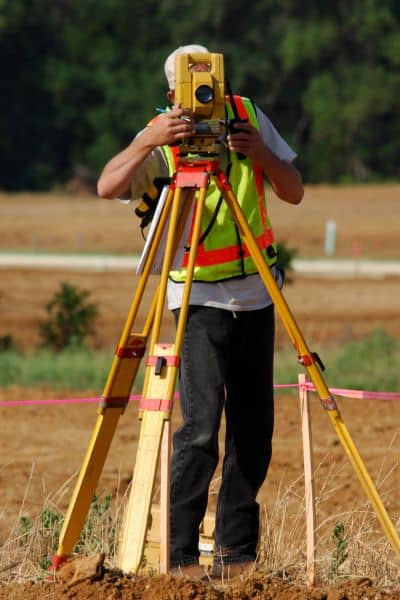
A boundary survey answers one clear question: where does your property begin and end?
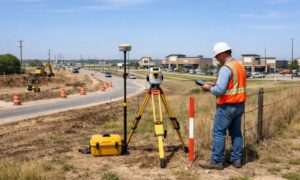
To find that answer, a licensed surveyor studies legal records, reviews past documents, and then visits the property. From there, they locate or set physical markers that match those records.
Because of this process, the results connect legal descriptions to real positions on the ground.
That’s the key difference.A boundary survey doesn’t rely on assumptions. Instead, it verifies everything through research and field work. So when you need to know your exact property line, this is the only method that gives a reliable answer.
How this mistake plays out in real life
Imagine you’re planning to add something next to your home. It could be a driveway extension or a small structure. So you pull out your site plan and measure the space. At first, it looks like everything fits.
Then, as the project moves forward, something doesn’t match.
The spacing feels tighter than expected. The layout doesn’t line up with what’s on paper. Now the project needs to pause while you figure out what went wrong.
In many cases, the issue comes down to using the wrong document from the start.
Because the site plan was never meant to confirm the boundary, the measurements don’t reflect the true property line. As a result, adjustments become necessary, and that can lead to delays.
Why this matters in Fort Worth
Fort Worth has a mix of older and newer properties. Some areas have tight lot spacing, while others have changes made over time. Because of that, property lines are not always obvious.
In addition, improvements like driveways, additions, and outdoor features often sit close to those lines. So even a small difference can affect a project.
That’s why relying on the right information matters more than people expect. When the space is limited, small errors can turn into bigger problems.
When a boundary survey becomes important
Not every situation requires a boundary survey. However, certain situations make it more important.
For example, if you’re planning to build near the edge of your property, accuracy matters. The same goes for any permanent improvement that depends on spacing.
Also, if different documents show different measurements, that’s a clear sign something needs to be checked.
In those moments, guessing doesn’t help. Instead, confirming the actual boundary early can prevent changes later.
Understanding the difference in a simple way
A site plan helps you see how things are arranged. It supports design and planning. However, it does not confirm ownership limits.
A boundary survey, on the other hand, defines where your property begins and ends. It is based on legal records and verified in the field.
So while both are useful, they answer very different questions.
Why this confusion keeps happening
This confusion keeps coming up because the documents look similar. They all show lines, shapes, and measurements. Because of that, it’s easy to assume they all serve the same purpose.
However, each one exists for a different reason.
So when someone uses a site plan to answer a boundary question, the result is uncertainty. That’s why this topic keeps coming up in real conversations. People aren’t dealing with bad data. They are simply using the wrong type of information.
Final thoughts
A site plan can look clear and detailed, but it does not define your property line. Only a boundary survey connects legal records to actual points on the ground.
So before you move forward with any project, take a moment to think about what you really need to know.
If the goal is layout, a site plan works.
But if the goal is to confirm where your property ends, a boundary survey is the right step.
Making that distinction early can save time, avoid changes, and keep your project moving in the right direction.